
Puzzle.io for SaaS Companies: The Complete Accounting Guide
Your SaaS company just closed a $50,000 annual contract. Payment arrives today. But that revenue shouldn't hit your P&L today. It should recognize over 12 months. Your investors want MRR, not lump-sum cash. Your board expects ARR growth trends. Your auditor demands ASC 606 compliance. Your CPA needs accrual books. Your team needs cash visibility. Your bank sees a big deposit. All simultaneously.
This is SaaS accounting. Complex enough that legacy accounting platforms require significant customization and manual work to handle properly. Painful enough that many SaaS founders default to spreadsheets for revenue recognition even after implementing QuickBooks or Xero. Expensive enough that traditional bookkeepers charge premium rates for SaaS-specific expertise.
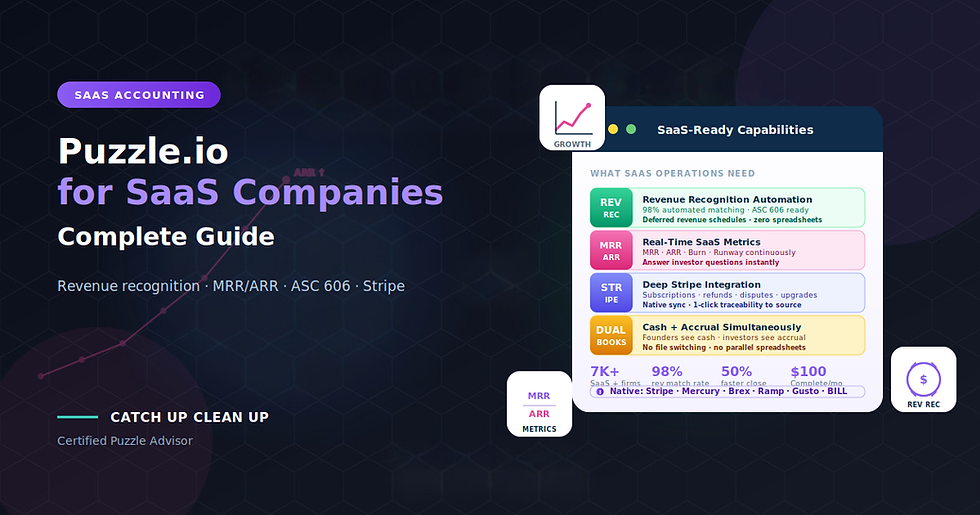
Puzzle.io is different. It's an AI-native accounting platform built with SaaS operations in mind from the start. Revenue recognition happens automatically. Dual cash and accrual books maintain simultaneously. MRR and ARR update in real time. Stripe subscription data flows natively into proper deferred revenue schedules. Every automated action traces back to its source transaction for full audit visibility.
This guide covers everything SaaS founders and finance leads need to know about Puzzle. Why SaaS accounting is fundamentally different from other business models. Which SaaS-specific metrics Puzzle tracks natively. How revenue recognition automation actually works. How the modern SaaS accounting stack fits together. When Puzzle is right for your SaaS (and when it isn't). And how a Certified Puzzle Advisor accelerates value for SaaS operations.
💡 Key Takeaways
SaaS accounting requires specialized handling for revenue recognition, deferred revenue, and subscription tracking
Puzzle's Revenue Recognition feature is generally available with 98% automated matching
Dual cash and accrual books maintain simultaneously without file switching or manual reconciliation
Native Stripe integration maps subscriptions, refunds, and disputes directly to deferred revenue schedules
Real-time MRR, ARR, burn, and runway available continuously without waiting for month-end close
ASC 606 compliance workflows automated across subscription revenue
Investor-ready reporting produced from real-time data
Certified Puzzle Advisors provide SaaS-specific expertise beyond platform automation
Why is SaaS accounting fundamentally different?
Before diving into Puzzle specifics, understanding what makes SaaS accounting genuinely different helps you evaluate why platform choice matters more for SaaS than for other business models.
The revenue timing mismatch
Traditional service businesses invoice and collect for work performed. Product businesses ship goods and receive payment. Both have relatively simple revenue recognition: the money comes in as the work happens or the product delivers.
SaaS breaks this pattern. Customers typically pay upfront for services delivered over time. A customer pays $12,000 in January for a 12-month subscription. GAAP requires you to recognize $1,000 per month over the subscription period, not $12,000 in January. This creates a permanent gap between cash flow and revenue recognition that requires careful accounting treatment.
The deferred revenue liability
That $12,000 January payment creates deferred revenue (a liability on your balance sheet) that gets released to revenue over time. Multiply this across dozens or hundreds of subscription customers with different subscription lengths, start dates, price changes, refunds, and cancellations, and you have a genuinely complex accounting picture.
Traditional accounting platforms handle this poorly. QuickBooks and Xero don't natively track deferred revenue schedules. Most SaaS finance teams end up maintaining separate spreadsheets to track subscription revenue, then manually posting journal entries each month to recognize the appropriate revenue. This creates error opportunities, audit friction, and hours of monthly work.
The MRR and ARR imperative
Investors, boards, and internal decision-making all require MRR (Monthly Recurring Revenue) and ARR (Annual Recurring Revenue) metrics. These aren't optional for SaaS operations. They're the primary metrics VCs evaluate for fundraising, that acquirers use for valuation, and that internal teams use for planning.
Traditional accounting platforms produce these metrics only through custom reporting or spreadsheet exports. Neither approach updates in real time. SaaS operations often lag their metrics by weeks or months, making it impossible to react quickly to trends.
The cash vs accrual paradox
SaaS founders manage the business on cash metrics. How much cash do we have? How fast are we burning it? How long is our runway? These questions require cash-basis visibility.
But investors, auditors, acquirers, and CPAs all require accrual-basis financial statements for their decision-making. Revenue recognition follows accrual rules. Financial reporting to investors uses accrual. Tax planning benefits from cash view.
Traditional accounting platforms force you to pick one method. You then maintain the other through spreadsheet reconciliation. This creates two versions of truth about your business that never quite align.
The subscription complexity spectrum
SaaS subscription complexity ranges dramatically. Simple flat monthly subscriptions ($99/month) require minimal accounting overhead. Complex enterprise deals with usage-based pricing, tiered discounts, custom terms, and multi-year contracts require sophisticated treatment.
Modern SaaS operations increasingly involve:
Annual contracts paid upfront
Multi-year contracts with escalators
Usage-based pricing with monthly true-ups
Tiered pricing with mid-cycle upgrades
Add-on services and modules
Trial periods with conversion tracking
Refunds and cancellations mid-cycle
Discounts, coupons, and promotional pricing
Handling this complexity requires either sophisticated accounting software or significant manual accounting work each month. There's no middle ground.
The compliance and audit reality
SaaS revenue recognition falls under ASC 606 (or IFRS 15 internationally), which requires specific treatment of subscription revenue including performance obligations, transaction price allocation, and timing of recognition. Getting this wrong creates audit findings, restatement risk, and investor concerns during due diligence.
Companies pursuing Series B or later funding, planning acquisitions, or preparing for IPO face significant scrutiny of their revenue recognition. Poor SaaS accounting foundations become expensive to fix during high-stakes moments.
For deeper context on modern startup accounting infrastructure, see our related guide on what is Puzzle.io: the complete guide for startup founders.
What SaaS-specific metrics does Puzzle track natively?
Puzzle's dashboard leads with metrics SaaS operations actually need, not generic accounting outputs.
Real-time financial metrics available continuously
Rather than waiting for month-end close to know your position, Puzzle updates these metrics continuously as transactions flow through the platform:
Cash and runway metrics:
Current cash balance across all connected accounts
Net cash burn (monthly cash consumption)
Runway calculation (cash divided by burn rate)
Cash trend over time
Days of runway remaining
Revenue metrics:
Monthly Recurring Revenue (MRR)
Annual Recurring Revenue (ARR)
Revenue by customer segment
Revenue by product or plan tier
Net revenue retention indicators
Operational metrics:
Expense breakdowns by category
Vendor spend analysis
Payroll versus other operating expenses
Marketing and sales spend efficiency
Why real-time matters for SaaS
Traditional accounting produces these metrics monthly. Puzzle produces them continuously. This changes what's possible operationally:
Investor updates without scrambling:When your investor emails asking for current metrics, you answer immediately rather than requesting time to compile reports. Real-time dashboard access removes the friction from investor communication.
Faster iteration on pricing and packaging:When you launch a new pricing tier or promotional offer, you see impact within days rather than waiting for monthly reports. Faster feedback enables faster iteration.
Earlier detection of churn or growth changes:Revenue trends that would take weeks to become visible in traditional systems appear in Puzzle almost immediately. Earlier detection enables earlier response.
Real fundraising positioning:During fundraising, you can share current metrics rather than metrics from three weeks ago. This positions you as operationally sophisticated and reduces investor concerns about data quality.
How Puzzle calculates SaaS metrics
Understanding the methodology matters because it affects reliability:
MRR calculation:Puzzle identifies recurring subscription revenue from your Stripe integration (and other billing sources), annualizes monthly components, and tracks changes over time. New subscriptions, upgrades, downgrades, and cancellations all reflect in MRR movements.
ARR calculation:ARR is MRR multiplied by 12, adjusted for contracts with different billing cadences. Puzzle handles annual, quarterly, and monthly billing frequencies appropriately, producing a consistent ARR figure that reflects the true annualized run rate.
Burn rate calculation:Puzzle calculates burn using net cash outflow. Revenue in minus expenses out equals net burn. Because transactions update continuously, burn rate updates continuously too, providing accurate current-period visibility.
Runway calculation:Runway is current cash divided by average burn rate. Puzzle uses recent burn history rather than single-month snapshots, producing a more accurate runway estimate that accounts for month-to-month variability.
How does Puzzle handle SaaS revenue recognition?
This is where Puzzle's advantages for SaaS become clearest. Revenue recognition is Puzzle's genuinely differentiated capability for SaaS operations, and it's now generally available across all customers.
The Puzzle revenue recognition workflow
Puzzle's Revenue Recognition feature automates accrual revenue across your entire modern financial stack. The workflow follows three steps:
Step 1: Connect your revenue stack
Puzzle integrates natively with your revenue sources:
Stripe for subscription billing
BILL for accounts receivable invoices
Mercury for interest revenue and invoice payments
Manual CSV upload for custom contracts
Each integration pulls transaction data continuously without requiring exports or manual imports.
Step 2: Automated mapping and matching
Puzzle automatically maps transactions to deferred revenue accounts and schedules amortization. For Stripe subscriptions, this means:
Monthly subscriptions post as immediate revenue
Annual subscriptions post to deferred revenue with monthly amortization schedules
Multi-year contracts get scheduled across the appropriate periods
Mid-cycle upgrades and downgrades adjust schedules automatically
Refunds reverse recognized revenue proportionally
The system reports 98% automated matching accuracy. The logic locks once configured so your revenue schedules remain fully traceable to the underlying transactions.
Step 3: Accountant review and posting
Puzzle drafts revenue schedules for review. Your accountant reviews the proposed entries in the dashboard and posts them to your general ledger with one click. This "accountant-reviewed, AI-drafted" approach maintains control while eliminating manual data entry.
The dual-book advantage
One of Puzzle's most powerful features for SaaS operations: dual books simultaneously.
Cash books for founders: Real-time visibility into cash burn, runway, and cash flow. Founders manage the business on cash metrics because cash is what actually runs out.
Accrual books for accountants and investors: Financial health and margins per GAAP standards. Investors, auditors, and CPAs work in accrual because that's what accounting standards require.
Puzzle maintains both simultaneously from the same underlying ledger. No file switching. No parallel spreadsheets. No manual reconciliation between methods. Both views update in real time from the same data.
This eliminates one of the most persistent friction points in SaaS accounting: the perpetual gap between how founders think about the business (cash) and how it must be reported (accrual).
The traceable audit trail
Every automated revenue schedule in Puzzle permanently links to its underlying source transaction. If you or an auditor need to verify a specific journal entry, clicking the number in your ledger pulls up the original Stripe subscription event, BILL invoice, or bank payout.
This traceability matters for SaaS operations because:
Auditors can verify revenue recognition without extensive walkthroughs
Due diligence during fundraising or M&A goes faster
Internal disputes about specific transactions get resolved quickly
Restatements or corrections have clear source references
ASC 606 compliance documentation happens automatically
Traditional SaaS accounting requires manual documentation of the connection between accounting entries and source transactions. Puzzle builds this documentation automatically as a byproduct of the automation.
Native Stripe integration depth
For SaaS operations running on Stripe (which is most of them), Puzzle's deep native Stripe sync is particularly valuable. Rather than treating Stripe as a generic payment processor, Puzzle understands Stripe's subscription model:
Stripe capabilities Puzzle handles natively:
High-volume subscription tracking
Subscription upgrades and downgrades
Mid-cycle plan changes
Refunds and disputes
Trial-to-paid conversions
Annual versus monthly billing frequencies
Add-on charges beyond subscriptions
Customer-level revenue attribution
This depth of integration eliminates the manual work of reconciling Stripe subscription events to accounting entries. It also enables customer-level revenue analysis that would require significant custom work in traditional platforms.
For related guidance on integration setup for other platforms, see our Shopify + A2X + Xero integration guide (different tool but similar principles).
What does the modern SaaS accounting stack look like?
Puzzle sits at the center of a broader accounting stack designed for SaaS operations. Understanding the ecosystem helps you evaluate whether the whole stack fits your needs.
The core stack components
Banking layer:
Mercury (most common for early-stage SaaS)
Brex (common for growth-stage)
Ramp (increasingly popular for combined banking and expense management)
Payment processing layer:
Stripe (near-universal for SaaS billing)
Braintree (alternative for some operations)
Direct ACH for enterprise contracts
Expense management layer:
Ramp (increasingly dominant)
Brex (common alongside their banking)
Bill.com (traditional AP)
Payroll and benefits layer:
Gusto (most common for early-stage SaaS)
Rippling (common for growth-stage with global operations)
Deel (essential for global contractor management)
Accounting foundation:
Puzzle (AI-native for modern operations)
QuickBooks Online (traditional alternative)
Xero (international alternative)
Adjacent tools that integrate:
BILL for accounts receivable
Various CRM systems (HubSpot, Salesforce)
Business intelligence tools (Fathom, Spotlight)
How Puzzle integrates natively
Puzzle's native integrations mean data flows without workarounds. For a typical SaaS operation:
Automatic data flows:
Stripe payments and subscription events flow to Puzzle for revenue recognition
Mercury or Brex banking transactions flow for cash tracking
Ramp or Brex expense transactions flow for expense categorization
Gusto or Rippling payroll flows for payroll accounting
Bill.com or manual AR flows for invoice-based revenue
What this eliminates:
Manual CSV exports and imports
Third-party sync tool subscriptions and setup
Reconciliation gaps between systems
Delayed data availability
Error opportunities at handoff points
For SaaS operations already running on these tools, Puzzle's native integrations mean setup measures in hours rather than weeks.
The alternative when integrations don't align
If your SaaS operation uses tools outside Puzzle's native integration set, Plaid connects to thousands of additional financial accounts. This provides functional bank feed access but without the depth of native integrations.
For most modern SaaS operations, the native integration set covers 80-90% of the financial stack. The Plaid fallback handles the remainder.
What Puzzle doesn't handle
Puzzle intentionally focuses on general ledger accounting. Your SaaS stack needs additional tools for:
Subscription billing management:
Stripe Billing (typical)
Chargebee, Recurly, or ChargeBee for complex billing
Zuora for enterprise complexity
Revenue operations and CRM:
HubSpot, Salesforce, or Close for pipeline management
MRR reporting inside these tools for sales team visibility
Financial planning and analysis:
Fathom, Spotlight, or Datarails for advanced reporting
Puzzle handles core financial statements; specialized tools handle FP&A
Contract lifecycle management:
DocuSign, PandaDoc for contract creation
Specialized tools for enterprise sales complexity
Puzzle plays well with these adjacent tools rather than trying to replace them.
When is Puzzle right for your SaaS operation?
Understanding when Puzzle makes sense (and when it doesn't) helps you evaluate objectively.
Strong Puzzle fit for SaaS
Modern SaaS on fintech stack: If your SaaS runs on Stripe, Mercury or Brex, Ramp, and Gusto, Puzzle is essentially built for you. The integrations align perfectly. Setup happens quickly. AI training uses clean data.
Growing SaaS between seed and Series B: This growth stage benefits particularly from Puzzle's approach. You need real revenue recognition automation but not enterprise complexity. You need investor-ready reporting but not full FP&A. You need to move fast but need audit-ready books.
SaaS preparing for fundraising: Fundraising due diligence requires clean revenue recognition, MRR/ARR trends, and clear audit trails. Puzzle produces these naturally. The traceable audit trail specifically accelerates diligence processes.
SaaS with revenue recognition complexity: Multi-year contracts, mid-cycle changes, refunds, and complex pricing all get handled automatically. This eliminates the spreadsheet-based revenue tracking that plagues most growing SaaS operations.
SaaS teams growing beyond 5 users:
Puzzle's unlimited users on Complete plan (versus QBO Plus limit of 5) matters as your team grows. Team members needing accounting access don't force you to premium tiers just for user seats.
QBO users hit by August 2026 price increase: The 41% QBO Plus price increase pushed many SaaS operations to evaluate alternatives. Puzzle Complete at $100-120/month offers better SaaS-specific features than QBO Plus at $140/month. See our QuickBooks price increase migration guide for detailed context.
When SaaS operations should consider alternatives
International SaaS with multi-currency operations: Puzzle is US-only. If your SaaS serves significant international customers or you're expanding internationally, Xero's native multi-currency handling makes more sense. Puzzle can be considered later if you establish US-based operations.
Enterprise SaaS with extreme complexity: Very large SaaS operations with complex multi-entity structures, sophisticated revenue arrangements, or heavy customization needs may need enterprise platforms (NetSuite, Sage Intacct). Puzzle handles most growing SaaS well but has limits at scale.
SaaS built entirely on Xero-focused stack: If your SaaS operates with tools that integrate deeply with Xero but not Puzzle, migration friction may outweigh Puzzle benefits. Evaluate the whole stack, not just accounting.
Pre-revenue SaaS with minimal operations: Very early-stage SaaS with minimal transactions may find Puzzle's Starter plan works but may not need its full capabilities yet. Wait until transaction volume justifies the platform investment.
SaaS accountants who prefer manual control: Puzzle's automation-first approach can create friction for accountants who prefer complete manual control over every entry. Traditional platforms give more granular manual override options.
The decision framework
Ask these questions to evaluate Puzzle for your SaaS:
Business model questions:
Is our billing primarily through Stripe or similar modern payment processors?
Do we have significant subscription revenue requiring recognition?
Do we run on modern fintech tools (Mercury, Brex, Ramp)?
Are we US-based or expanding internationally?
Growth stage questions:
Are we preparing for fundraising in the next 12-24 months?
Do we need real-time metrics for investor updates?
Is our team growing beyond 5 users?
Are we planning M&A activity or IPO?
Current pain questions:
Do we maintain revenue recognition in spreadsheets?
Does month-end close take longer than we'd like?
Do our books lag our operations by weeks or months?
Are we frustrated with QBO or Xero limitations?
If most answers align with Puzzle's strengths, evaluation is worthwhile. If most answers push toward international, enterprise, or non-SaaS characteristics, other platforms may fit better.
What are the SaaS-specific setup considerations?
Setting up Puzzle for SaaS operations requires attention to elements that generic setup guides skip.
Chart of accounts for SaaS
Your chart of accounts needs SaaS-specific structure:
Revenue accounts:
Subscription Revenue (main SaaS revenue)
Setup and Onboarding Revenue (one-time services)
Professional Services Revenue (if applicable)
Add-on and Module Revenue (if applicable)
Discount and Promotional Revenue (contra-revenue)
Deferred revenue accounts:
Current Portion of Deferred Revenue (recognizing within 12 months)
Long-term Deferred Revenue (recognizing beyond 12 months)
Deferred Revenue by product line if reporting granularly
Expense categorization:
Cost of Revenue (hosting, infrastructure, customer success)
Sales and Marketing (with clear separation)
Research and Development
General and Administrative
Non-recurring or unusual items
Balance sheet accounts:
Accounts Receivable (for annual invoices)
Prepaid expenses
Accrued expenses
Sales commissions (if amortizing)
Getting this structure right upfront avoids restructuring later.
Revenue recognition configuration
For each SaaS billing pattern, revenue recognition rules need configuration:
Monthly subscriptions:
Recognize revenue in the month of service
Simple treatment, minimal configuration needed
Annual subscriptions billed monthly:
Recognize as billed (matches cash flow)
Simple treatment for these arrangements
Annual subscriptions paid upfront:
Post initial payment to deferred revenue
Schedule monthly amortization over 12 months
Automate through Puzzle's revenue recognition
Multi-year subscriptions:
Post initial payment to deferred revenue
Schedule amortization across contract term
Handle price escalators if applicable
Usage-based components:
Recognize as usage occurs
May require monthly true-up entries
Integration with billing data critical
Setup or implementation fees:
Determine if separate performance obligation
Amortize or recognize based on ASC 606 treatment
May require accountant judgment
Stripe integration setup
Deep Stripe integration setup benefits from careful configuration:
Configure product and pricing mapping:
Map each Stripe product to appropriate revenue account
Handle multiple pricing tiers within products
Configure discount treatment
Set up refund handling
Configure customer categorization:
Enterprise vs SMB segmentation
Geographic segmentation if relevant
Product line segmentation
Configure subscription lifecycle handling:
Trial-to-paid conversion tracking
Upgrade and downgrade handling
Cancellation and reactivation
Failed payment recovery
Verify metadata usage:
Custom metadata fields for reporting
Customer attribution
Sales channel tracking
Proper Stripe configuration eliminates most manual revenue recognition work.
Initial data migration considerations
For SaaS operations migrating from other platforms:
From QuickBooks Online:
Historical subscription data may not transfer cleanly
Deferred revenue balances need verification
Consider migration timing (start of quarter often best)
White-glove migration on Complete plan handles complexity
From Xero:
Similar considerations to QBO migration
Multi-currency history won't transfer (Puzzle is US-only)
Tracking Categories don't have direct equivalent
From spreadsheet-based bookkeeping:
Enter opening balances as of cutover date
Historical detail typically lost (spreadsheet exports become archive only)
Focus on getting forward-looking books clean
Setup timeline expectations:
Basic setup: days
AI training and refinement: 30-60 days
Full productivity: 60 days
Historical migration adds additional time based on scope
For related migration guidance, see our how to fix a broken Shopify + A2X + QuickBooks Online integration (different tool but similar migration principles).
What are common SaaS accounting mistakes Puzzle prevents?
Many SaaS accounting problems trace back to specific mistakes that Puzzle's structure prevents by design.
Mistake 1: Recognizing annual subscriptions as revenue when received
The most common SaaS accounting error. A customer pays $12,000 for annual subscription, and it gets recorded as $12,000 revenue in that month. The correct treatment is deferring the revenue and recognizing $1,000 per month.
How Puzzle prevents this: Native Stripe integration understands subscription duration and automatically creates deferred revenue schedules. The correct treatment happens automatically rather than requiring manual journal entries each month.
Mistake 2: Maintaining deferred revenue in spreadsheets
Even SaaS operations that understand proper revenue recognition often track deferred revenue in spreadsheets separate from their accounting system. Each month someone manually calculates recognition and posts entries.
How Puzzle prevents this: Revenue recognition happens automatically within the accounting platform. No parallel spreadsheets to maintain. No manual monthly entries to post. The audit trail links every recognition entry back to the source subscription.
Mistake 3: Missing revenue for mid-cycle changes
When customers upgrade or downgrade mid-subscription, revenue recognition should adjust proportionally. Many SaaS operations miss these adjustments entirely, either overstating or understating revenue.
How Puzzle prevents this: Stripe integration captures subscription changes in real time. Puzzle automatically adjusts recognition schedules based on the new subscription structure, with proper handling of pro-rated amounts.
Mistake 4: Improper refund handling
When SaaS customers get refunds, the treatment matters. Refunds should reverse previously recognized revenue proportionally and adjust remaining deferred revenue. Many operations either miss these adjustments or handle them incorrectly.
How Puzzle prevents this: Stripe refund events flow through the integration automatically. Puzzle handles the accounting entries including reversing recognized revenue, adjusting deferred revenue balances, and maintaining the audit trail.
Mistake 5: Netting Stripe fees against revenue
Stripe deducts processing fees from payments before depositing net amounts to your bank. Many SaaS operations record only the net amount as revenue, which understates both true revenue and true processing costs.
How Puzzle prevents this: Stripe integration records gross revenue and processing fees separately. This preserves accurate revenue reporting and enables true unit economics analysis (revenue vs cost of processing).
Mistake 6: Missing sales tax on subscription revenue
Depending on state and product classification, SaaS subscriptions may be subject to sales tax. Many operations either miss this obligation entirely or handle it inconsistently.
How Puzzle handles this: While Puzzle isn't designed for complex multi-state sales tax like QBO's Automated Sales Tax, it works with third-party sales tax tools that integrate with Stripe. The overall stack handles sales tax appropriately when configured correctly.
Mistake 7: Failing to accrue commissions
Sales commissions on annual contracts require careful treatment. ASC 606 requires amortizing certain commissions over the customer relationship period, which can be multiple years.
How Puzzle helps: Puzzle's Accrual Automation feature handles prepaid expenses and similar accruals. For commissions specifically, careful configuration and often accountant judgment ensure proper treatment.
Mistake 8: Poor ASC 606 documentation
Auditors reviewing SaaS revenue recognition need clear documentation of the recognition methodology and supporting transaction detail. Many operations struggle to produce this documentation efficiently.
How Puzzle prevents this:The traceable audit trail links every recognition entry to source transactions. Documentation exists automatically rather than requiring separate compilation. Audit walkthroughs go significantly faster.
Mistake 9: Delayed month-end close
Traditional SaaS accounting often produces closed books weeks after month-end. This delay makes reports stale by the time they're available, limiting operational value.
How Puzzle prevents this:Continuous data flow means close activities happen throughout the month. Month-end becomes verification rather than reconstruction. Complete plan customers benefit from the 50% faster close guarantee.
Mistake 10: Inability to answer real-time questions
When investors, board members, or executives ask about current metrics, traditional operations require days to compile answers. This delay creates friction and signals operational immaturity.
How Puzzle prevents this:Real-time dashboards mean answers exist immediately. Current cash, current burn, current runway, current MRR, current ARR all display continuously. Answering investor questions becomes trivial.
How does working with a Certified Puzzle Advisor help SaaS operations?
Puzzle is powerful software, but SaaS accounting complexity often benefits from expert advisor support. Understanding when advisor help adds value beyond the platform itself
matters for evaluating your overall SaaS accounting approach.
Where software handles alone
For simpler SaaS operations, Puzzle alone can handle:
Basic subscription revenue recognition
Standard chart of accounts
Bank reconciliation
Standard financial reporting
Real-time metrics tracking
Early-stage SaaS with straightforward operations often runs successfully with Puzzle plus founder oversight.
Where advisor expertise adds value
As SaaS operations grow in complexity, advisor expertise becomes important for:
Complex revenue recognition scenarios:
Multi-year contracts with escalators
Contracts with multiple performance obligations
Setup fees and their proper treatment
Discount and promotional accounting
Standalone selling price analysis
Fundraising and diligence preparation:
Ensuring books are truly audit-ready
Preparing revenue recognition documentation
Handling investor and diligence team questions
Coordinating with legal and financial diligence teams
Complex expense scenarios:
Sales commission amortization
Deferred customer acquisition costs
Contract cost capitalization
R&D expense treatment
Growth planning support:
Investor reporting preparation
Metrics analysis and interpretation
Financial planning support
Strategic decision analysis
Tax coordination:
Startup-specific tax planning
R&D credit documentation
QSBS qualification tracking
International considerations
The Puzzle Certification program
Puzzle offers formal certification training for accounting firms. Certified Puzzle Advisors complete this training and demonstrate proficiency with the platform. Puzzle maintains a directory of Certified Advisors that startups can use to find qualified help.
What certification signals:
Deep platform expertise beyond typical user knowledge
Understanding of SaaS-specific accounting best practices
Ability to leverage Puzzle's capabilities fully
Ongoing training on new features and capabilities
How to find Certified Puzzle Advisors: Puzzle maintains a public directory of Certified Advisors that SaaS operations can search based on specialization, location, and firm characteristics. This directory provides pre-vetted options rather than requiring independent evaluation.
Catch Up Clean Up is a Certified Puzzle Advisor, positioned to help SaaS operations leverage Puzzle's full capabilities while receiving expert accounting support tailored to SaaS operations.
What advisor relationships look like
Effective SaaS advisor relationships typically involve:
Setup and configuration:
Initial Puzzle configuration for SaaS
Chart of accounts design
Revenue recognition setup
Integration configuration
Monthly bookkeeping:
AI-drafted work review
Complex transaction handling
Judgment calls on unusual items
Financial statement review
Quarterly deep review:
Trend analysis and interpretation
Investor report preparation
Tax planning coordination
Growth-related structural decisions
Annual and event-based support:
Year-end reconciliation
Audit support
Fundraising diligence preparation
M&A support if applicable
The pattern is expert human review layered on top of AI-powered automation, producing accurate books faster than either alone.
The Bottom Line
SaaS accounting complexity requires purpose-built tools. Legacy accounting platforms handle SaaS operations only through significant customization, spreadsheet workarounds, and manual monthly work. Modern SaaS operations increasingly need accounting infrastructure that matches their operational sophistication.
Puzzle.io is genuinely differentiated for SaaS operations. The AI-native architecture handles revenue recognition automatically. The dual cash and accrual books eliminate the perpetual gap between founder and accountant views. The real-time metrics answer investor questions immediately. The native Stripe integration eliminates manual subscription tracking. The traceable audit trail simplifies compliance and diligence.
For US-based SaaS on modern fintech stack, Puzzle deserves serious evaluation. The pricing is competitive (particularly following the August 2026 QuickBooks Online price increase). The setup is fast. The features match what SaaS operations actually need. And the platform continues improving rapidly with AI-native capabilities that legacy platforms cannot match.
But Puzzle isn't universal even for SaaS. International SaaS needs multi-currency handling Puzzle doesn't provide. Enterprise SaaS with extreme complexity may need enterprise platforms. Pre-revenue SaaS may find the platform overpowered for current needs. The right question is always "does Puzzle fit our specific SaaS operation" rather than "is Puzzle good."
For SaaS operations where Puzzle fits, the combination of platform plus Certified Puzzle Advisor delivers a genuinely modern accounting operation. Automated revenue recognition. Real-time metrics. Investor-ready reporting. Audit-ready documentation. Expert judgment where needed. Dramatic time savings on routine work. The pattern that grows well as SaaS operations scale from seed through Series B and beyond.
Making the right accounting infrastructure choice matters more for SaaS than most business models. Bad choices compound with growth, creating expensive fixes at high-stakes moments like fundraising or acquisition. Good choices scale gracefully, supporting operations through growth rather than becoming obstacles.
Whether Puzzle turns out to be right for your SaaS or not, the shift toward AI-native accounting continues accelerating. Traditional platforms will keep integrating AI features but never as seamlessly as platforms built AI-first. Understanding the modern SaaS accounting landscape helps you make informed choices as your business grows through its critical scaling phases.
Ready to evaluate whether Puzzle fits your SaaS operation?
Most SaaS founders we work with came to us with similar accounting frustrations. Revenue recognition happening in spreadsheets. Month-end close taking weeks. Investors asking for metrics that took days to compile. QuickBooks feeling increasingly limiting as the business grew. Certified Puzzle Advisor status specifically qualifies us to help SaaS operations evaluate whether Puzzle solves these problems for their specific situation.
At Catch Up Clean Up, we're a Certified Puzzle Advisor with deep experience across the modern SaaS accounting stack. We can evaluate objectively whether Puzzle fits your SaaS, help you make an informed decision, and if Puzzle is the right choice, execute the implementation and provide ongoing SaaS-specific expertise.
What you get:
A 30-minute scoping call to assess your SaaS accounting situation
Objective evaluation of whether Puzzle fits your operation
Cost-benefit analysis specific to your SaaS business
SaaS metrics assessment (MRR/ARR tracking readiness)
Revenue recognition complexity evaluation
Recommended platform decision with clear rationale
If Puzzle recommended: complete setup with proper SaaS configuration
Chart of accounts design optimized for SaaS operations
Stripe integration setup with deferred revenue automation
Native integration setup (Mercury, Brex, Ramp, Gusto)
Historical data migration if switching from another platform
Ongoing monthly bookkeeping leveraging Puzzle's AI
Real-time SaaS metrics dashboards
Investor-ready reporting support
ASC 606 compliance guidance
Certified Puzzle Advisor expertise throughout
Book a free consultation and let's evaluate whether Puzzle is right for your SaaS operation.
Frequently Asked Questions
Is Puzzle.io good for SaaS companies?
Yes. Puzzle is particularly well-suited for SaaS operations due to its native revenue recognition automation, dual cash and accrual books, real-time MRR/ARR tracking, and deep Stripe integration. Puzzle handles subscription revenue complexity that requires manual work in traditional accounting platforms.
How does Puzzle handle SaaS revenue recognition?
Puzzle's Revenue Recognition feature automates accrual revenue across Stripe, BILL, Mercury, and custom invoices. The system automatically maps subscription transactions to deferred revenue accounts and schedules amortization. 98% of transactions match automatically, with accountant review before posting to the general ledger.
Can Puzzle track MRR and ARR in real time?
Yes. Puzzle tracks Monthly Recurring Revenue (MRR) and Annual Recurring Revenue (ARR) continuously as transactions flow through the platform. These metrics update in real time rather than requiring month-end close. This enables SaaS operations to answer investor questions immediately.
Does Puzzle handle ASC 606 compliance?
Puzzle supports ASC 606 compliance workflows through its revenue recognition automation, deferred revenue tracking, and traceable audit trail. Complex ASC 606 scenarios (multi-year contracts, multiple performance obligations, standalone selling price analysis) benefit from Certified Puzzle Advisor expertise alongside the platform automation.
How does Puzzle compare to QuickBooks for SaaS operations?
Puzzle offers native revenue recognition automation, real-time SaaS metrics, and deep Stripe integration that QBO doesn't provide natively. QBO has broader third-party app ecosystem and better inventory support. For pure SaaS operations, Puzzle typically wins. For hybrid SaaS plus significant inventory operations, QBO may work better.


Comments