
When DIY Shopify Bookkeeping Stops Being Worth It
Almost every Shopify seller starts out doing their own bookkeeping. It makes sense, early-stage businesses don't have the revenue to justify hiring help, the volume is manageable, and entering a few transactions a week feels like something a founder can handle alongside everything else. But somewhere along the way, DIY bookkeeping stops being worth it. The question is when, and that question matters because the longer you wait to make the switch, the more expensive the eventual catch-up bookkeeping or clean-up accounting engagement becomes.
This guide gives you a clear decision framework. We'll cover the specific signals that DIY has stopped working, the math of bookkeeper-vs-founder time, the warning signs that you've already crossed the line, and what to do when DIY catch-up bookkeeping turns into a problem that needs professional help.
The Honest Math: DIY Costs More Than It Looks Like
Most Shopify sellers calculate the cost of DIY bookkeeping by thinking only about the cash they save. The actual cost has four components:
1. Time cost. A founder doing their own Shopify bookkeeping spends anywhere from 4-15 hours per month on it, depending on transaction volume and complexity. At a founder hourly value of $50-150, that's $200-2,250 per month in opportunity cost.
2. Error cost. DIY books are usually wrong in ways the founder doesn't see. Common errors: payouts treated as deposits, sales tax mixed with revenue, inventory never tracked, ad spend uncategorized. These errors compound monthly and create downstream cleanup work.
3. Tax cost. DIY books almost always miss legitimate deductions. Most sellers we catch up have been overpaying taxes by $5,000-25,000 annually because expenses weren't properly tracked.
4. Decision cost. Without accurate financials, business decisions become guesses. Scaling unprofitable products, missing cash flow problems, over-investing in losing ad channels, all of these cost real money over time.
A founder who "saves" $300/month by doing their own books often costs themselves $1,500-3,000/month across these four categories. The DIY savings are mostly illusory.
The 7 Signals DIY Has Stopped Working
DIY bookkeeping stops being worth it at different points for different sellers. Recognize any of these signals in yourself? It's probably time.
Signal #1: You're Behind More Than One Month
Catching up one missed month is annoying but manageable. Two months gets harder. Three months feels overwhelming. Once you're consistently behind by more than a month, the cycle rarely reverses on its own, it just gets worse until catch-up bookkeeping becomes necessary.
If you've been "meaning to catch up" for more than a few weeks, you've already passed the threshold where DIY is working.
Signal #2: Your Revenue Has Crossed $250,000
For most Shopify stores, $250K annual revenue is the rough threshold where DIY bookkeeping starts breaking down. Below that, transaction volume is low enough that a careful founder can keep up. Above that, complexity outpaces what's manageable alongside running the business.
Common indicators at this revenue level:
100+ orders/month requiring categorization
Multi-state sales tax obligations starting to surface
Multiple ad platforms with spend that needs proper tracking
Inventory complexity worth tracking properly
Tax filings that need accurate financial statements
Signal #3: You've Added a Second Sales Channel
Single-channel Shopify is manageable for DIY. Adding Amazon, TikTok Shop, wholesale through Faire, or any other channel multiplies the complexity dramatically. Each channel has its own:
Payout structure and timing
Fee categorization
Sales tax treatment (especially marketplace facilitator rules)
Inventory implications
Returns and refunds handling
Multi-channel sellers who try to DIY their bookkeeping almost universally end up needing catch-up bookkeeping within 6-12 months.
Signal #4: You're Selling Internationally
Multi-currency Shopify accounting is genuinely hard. Foreign exchange gains and losses, VAT and GST obligations, payouts in foreign currencies, these are areas where DIY mistakes compound quickly. Most founders aren't trained in multi-currency accounting, and the errors aren't visible until something major (like a tax filing or financing application) surfaces them.
Signal #5: You Got a Sales Tax Notice From a State
This is one of the loudest signals that DIY has stopped working. If you've received any notice from a state tax authority, about economic nexus, missing returns, or unpaid sales tax, clean-up bookkeeping is no longer optional. The penalty exposure grows monthly until properly addressed.
Signal #6: You Can't Answer Basic Financial Questions
A simple self-test: can you answer these from memory or within 2 minutes?
What was last month's gross revenue?
What's your gross margin?
How much did you spend on ads last month?
What's in your business checking account right now?
How much sales tax do you owe and to whom?
If any of these takes longer than 2 minutes or you can't answer them confidently, your bookkeeping isn't producing the information it should, which means either DIY has stopped working or your books need catch-up bookkeeping.
Signal #7: You're Avoiding QuickBooks (or Xero)
This is the most reliable subjective signal. If logging into your accounting software produces anxiety, if you keep "meaning to deal with it" but never actually do, if you delete the reminders to reconcile, your subconscious already knows DIY has stopped working.
Avoidance is a leading indicator of catch-up bookkeeping becoming necessary. The cycle predictably progresses: fall behind a little, avoid it, fall behind more, avoid it harder, eventually need professional cleanup.
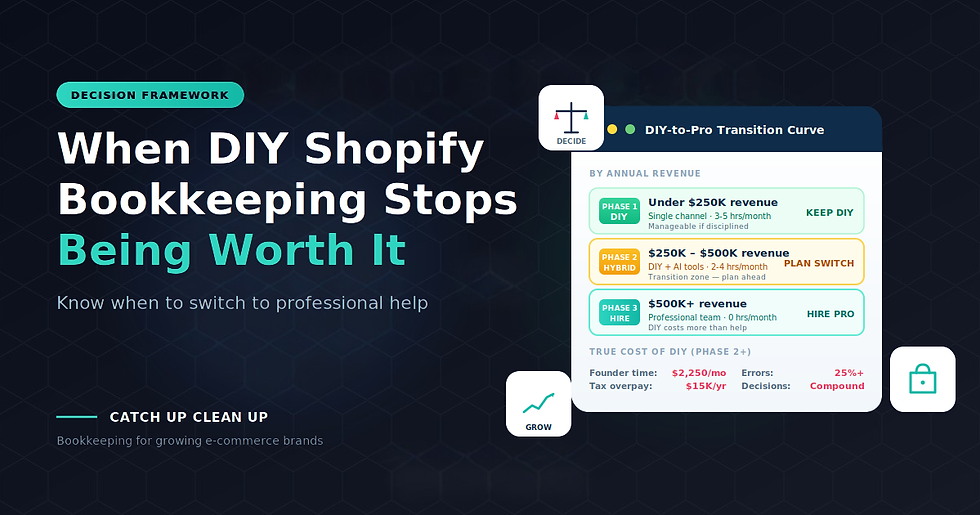
The DIY-to-Professional Transition Curve
Most Shopify sellers progress through three distinct phases of bookkeeping. Knowing which phase you're in helps you plan the transition.
Phase 1: True DIY (Pre-Revenue to ~$100K)
You enter every transaction. You reconcile monthly. You produce your own P&L (or use Shopify reports as proxy). Bookkeeping takes 3-5 hours/month and stays manageable because volume is low.
This phase works if: You're disciplined, you have accounting basics down, and your store is single-channel and US-only.
This phase breaks down when: Volume crosses ~50 orders/month, multi-channel emerges, or you simply run out of bandwidth.
Phase 2: Hybrid DIY + Tools (~$100K to ~$500K)
You're still doing core bookkeeping, but you've added AI sync tools like A2X or Link My Books to handle Shopify Payouts automatically. You use receipt capture (Dext, Hubdoc). Bookkeeping drops to 2-4 hours/month because tools handle the repetitive work.
This phase works if: Tools are set up properly, you understand what they're doing, and you maintain monthly reconciliation discipline.
This phase breaks down when: Multi-state sales tax emerges, you fall behind for more than a month, or store complexity outpaces what tools can automate.
Phase 3: Professional Bookkeeping (~$500K+)
You're no longer doing the day-to-day work. A specialist firm or in-house bookkeeper handles transactional work, reconciliation, and financial reporting. You review monthly statements and focus on business decisions, not bookkeeping mechanics.
This phase makes sense when: Your time is worth significantly more in business operations than in bookkeeping, complexity exceeds reasonable DIY capability, or you've already fallen behind enough to need catch-up bookkeeping.
The transition between Phase 2 and Phase 3 is where most Shopify sellers struggle. They stay in Phase 2 too long, fall behind, and end up needing both catch-up bookkeeping for the past and ongoing professional support going forward.
The "Should I Hire" Decision Framework
When you're trying to decide whether to keep DIYing or bring in help, run through this framework:
Calculate Your True Hourly Bookkeeping Cost
Step 1: Honestly estimate hours spent monthly on bookkeeping (be generous, include time you spend thinking about it, not just doing it).
Step 2: Multiply by your founder hourly value (what you're worth on revenue-generating work).
Step 3: Add a 25% error/quality discount (because DIY books are usually less accurate than professional books).
Step 4: Add estimated annual tax overpayment from missed deductions ($5,000-25,000 for most sellers).
Compare this total to what professional bookkeeping would actually cost. For most growing Shopify sellers, the comparison isn't close.
Run the Risk Math
Question 1: What's your exposure if your books are wrong?
Tax filing errors
Missed sales tax obligations
Bad business decisions
Financing application failures
Question 2: What's your exposure if your books are late?
Lost deductions
Compounding catch-up costs
Question 3: What's your exposure if you spend founder time on bookkeeping vs. business growth?
Slower customer acquisition
Worse strategic decisions
Missed opportunities
For most sellers, all three risk categories favor professional bookkeeping once revenue crosses $250K-$500K.
Test Your DIY Quality Honestly
Pull up your current QuickBooks Online or Xero file. Check:
Does the bank balance match your actual bank?
Are Shopify Payouts properly broken into components?
Is sales tax in a liability account or mixed with revenue?
Can you generate a P&L for last month right now?
Are your bank and credit card accounts reconciled through last month?
If the answer to any of these is "no" or "I'm not sure," DIY isn't working as well as you think, and clean-up bookkeeping is probably already needed.
What DIY Catch-Up Bookkeeping Actually Looks Like
Some founders, when they realize DIY current-period bookkeeping has failed, try to DIY the catch-up bookkeeping work itself. This rarely succeeds. Here's why:
The work compounds. Each missed month creates dependencies for subsequent months. Catching up 6 months in order takes longer than 6x the time of doing one month, because each month has to be verified before moving forward.
The complexity increases. A simple 3-month catch-up requires Shopify Payout reconciliation, multi-channel reconciliation, sales tax verification, inventory accounting, and tax-period closing. DIY catch-up requires expertise across all of these simultaneously.
The avoidance pattern resurfaces. If you couldn't keep up with one month at a time, finding 20+ hours of focused weekend time to catch up multiple months is unlikely.
The errors persist. DIY catch-up bookkeeping often produces work that has to be redone professionally before tax filing, meaning you've paid for it twice.
For more on the systematic approach professional bookkeepers use, see our Shopify QuickBooks catch-up and clean-up guide.
The Cost of Waiting Too Long
Every month of DIY-while-falling-behind adds to the eventual catch-up bookkeeping cost. The math is brutal:
3 months behind: Typical catch-up cost $1,500-3,000
6 months behind: Typical catch-up cost $2,500-5,500
12 months behind: Typical catch-up cost $4,000-9,000
24 months behind: Typical catch-up cost $8,500-18,000
36+ months behind: Typical catch-up cost $15,000-35,000+
Full pricing details in our Shopify catch-up bookkeeping cost guide. The pattern is clear: the cost roughly doubles every 12 months of additional delay.
A founder who delays the DIY-to-professional transition by a year often pays the entire year's professional fees ($3,600-12,000) in the increased catch-up bookkeeping cost alone, plus penalties, missed deductions, and operational decisions made on bad data.
When to Make the Switch
The clearest signal is when one or more of these apply:
Immediate switch needed:
You've received any tax notice
You're applying for financing within 90 days
Tax deadline is within 60 days and you don't have current books
You're more than 6 months behind
You're selling the business or doing M&A diligence
Switch within 30 days:
Revenue has crossed $500K
You've added a second sales channel
You're starting to sell internationally
You've been behind for 3+ months
You're spending more than 8 hours/month on bookkeeping
Switch within 90 days:
Revenue between $250K-$500K
Single channel but growing fast
DIY taking 4-8 hours/month
You feel chronic anxiety about books
Continue DIY if:
Revenue under $250K and stable
Single-channel, US-only
DIY takes less than 4 hours/month
You're consistently on top of monthly close
You have accounting background or training
What to Do When DIY Has Already Failed
If you're reading this and recognizing yourself in the warning signs, here's the path forward:
Step 1: Stop the Bleeding First
Before catching up the past, make sure the present isn't getting worse. Connect AI sync tools, get receipt capture running, ensure bank feeds are flowing. This creates a clean go-forward baseline while you address the past.
Step 2: Honestly Assess Your Position
How far behind are you really? Be generous in your estimate. Most founders underestimate by 30-50%. The honest answer is what shapes the right engagement.
Step 3: Get Scoped Quotes for Catch-Up Bookkeeping
Most catch-up engagements run $1,500-7,500 for typical Shopify stores. Get 2-3 quotes from specialist firms (not generalists). For specifics on what to look for, see our guide to hiring a Shopify bookkeeper.
Step 4: Set Up Forward-Looking Bookkeeping
The catch-up bookkeeping is only valuable if you don't end up in the same situation 12-18 months later. Use the catch-up engagement to establish:
Automated bank feeds
AI sync tools running continuously
Monthly close routine
Receipt capture
Either ongoing internal or outsourced bookkeeping support
Step 5: Focus on What You're Actually Good At
The biggest win of stopping DIY isn't the bookkeeping itself, it's redirecting your time to revenue-generating work. Most founders we work with see business growth accelerate within 60-90 days of getting books off their plate.
Common Excuses That Keep Founders Stuck in DIY
If you find yourself making any of these arguments, they're usually rationalizations for avoidance rather than actual reasons:
"I can't afford a bookkeeper right now." The math almost always says otherwise once you account for your time, errors, and tax overpayment. If you're growing, you can afford a specialist; if you're not growing, the bookkeeper might help you figure out why.
"My books aren't that bad." Most founders dramatically underestimate how messy their books actually are. The self-perception of "manageable" is often disconnected from the reality professionals would see.
"I'll catch up after [next launch / next quarter / tax season]." This is the avoidance loop. There's never a perfect time. The right time is always "now," because the cost only grows with delay.
"I'll just hire someone cheap to fix it." Cheap catch-up bookkeeping usually requires expensive re-work. Specialist pricing is the correct pricing for specialized work.
"I'm too embarrassed to show my books to someone." Every professional bookkeeper has seen worse. Whatever combination of mess you have, we've handled it before. Shame is not a productive emotion when there's actual work to do.
The Bottom Line
DIY Shopify bookkeeping is fine, until it isn't. The transition point varies by founder, but it's usually somewhere between $250K-$500K annual revenue, when complexity outpaces what's reasonable to handle alongside running the business. Once you're past that point, continuing to DIY costs more than hiring help, regardless of how the math looks on the surface.
If you've already fallen behind, catch-up bookkeeping or clean-up accounting work isn't optional, it just becomes more expensive the longer you wait. The right time to address it is when you first recognize the warning signs, not when an external deadline forces your hand.
Ready to Stop Doing Your Own Books?
Most Shopify sellers we work with come to us at a specific moment of clarity, usually after a tax notice arrives, a financing application stalls, or simply after one too many months of "I'll catch up next week." The relief of finally getting bookkeeping off their plate is consistently described as one of the most impactful business decisions they've made.
At Catch Up Clean Up, we handle both the catch-up bookkeeping work for whatever shape your current books are in, and the ongoing monthly bookkeeping that keeps them current going forward. Specialist e-commerce expertise, modern AI tools, flat-rate pricing, CPA-ready output.
What you get:
A 30-minute scoping call to assess your specific situation
A written flat-rate quote with clear scope and timeline
Full catch-up bookkeeping using A2X, Link My Books, or equivalent AI tools
CPA-ready financial statements with proper documentation
Optional ongoing monthly bookkeeping at predictable pricing
Book a free consultation, and let's figure out whether DIY is still working for you or whether it's time to make the switch.
Frequently Asked Questions
When should I stop doing my own Shopify bookkeeping?
The clearest signals: revenue crosses $250-500K annual, you've added a second sales channel, you've been behind for 3+ months, you've received any tax notice, or you're spending more than 8 hours per month on bookkeeping. Most Shopify sellers should transition between $250K and $500K in annual revenue, before catch-up bookkeeping becomes necessary.
Is it worth hiring a bookkeeper for my Shopify store?
Almost always yes once revenue crosses $250K, and definitively yes once it crosses $500K. The math favors professional bookkeeping when you account for founder time, error reduction, tax savings, and better business decisions. The "savings" from DIY bookkeeping are usually illusory once you calculate the full cost.
How do I know if my Shopify books need clean-up bookkeeping?
The most reliable self-check: open QuickBooks or Xero, look at the bank balance, and compare it to your actual bank balance. If they don't match, your books need attention. Other signs: Shopify Payouts posted as raw deposits, sales tax mixed with revenue, transactions in "Ask My Accountant," or you can't easily produce last month's P&L.
Can I catch up my own Shopify bookkeeping if I've fallen behind?
You can if you're only 1-3 months behind, your store is simple, and you have 20+ hours of focused time. For most sellers 6+ months behind or with multi-channel operations, DIY catch-up bookkeeping rarely succeeds, and the work often has to be redone professionally afterward. Better to hire specialists once you've fallen behind.
How much does it cost to hire a Shopify bookkeeper instead of doing it myself?
Ongoing monthly bookkeeping for Shopify stores typically runs $300-1,500 per month depending on complexity and revenue. Catch-up bookkeeping engagements run $1,500-15,000+ depending on how far behind you are. For most growing Shopify sellers, the professional cost is dramatically less than the true cost of DIY (time + errors + tax overpayment).
What's the difference between catch-up bookkeeping and clean-up bookkeeping?
Catch-up bookkeeping fills in missing data (periods where no transactions were entered). Clean-up bookkeeping fixes wrong data (transactions that were entered incorrectly). Most Shopify sellers who fall behind need both, some periods have nothing, others have errors. Professional engagements typically quote them together.
What happens if I keep doing DIY bookkeeping when I shouldn't?
The most common outcomes: tax filing errors that lead to amended returns or IRS scrutiny, missed sales tax obligations that accumulate penalties, bad business decisions made on inaccurate data, lost financing opportunities, and eventually a much larger and more expensive catch-up bookkeeping engagement than would have been needed if you'd transitioned earlier.


Comments