
Why Modern Startups Are Moving Beyond QuickBooks: The Rise of AI-Native Accounting
Something structural is happening in startup accounting. It's not just the August 2026 QuickBooks Online price increases pushing companies to evaluate alternatives, though those hikes definitely accelerated the conversation. It's not just AI marketing hype from accounting software vendors, though that's certainly noisy. It's not even just the emergence of interesting new platforms, though several genuinely differentiated options now exist.
What's happening is a generational shift in accounting software architecture. For the first time since QuickBooks Online replaced desktop accounting in the early 2000s, the underlying assumptions about how accounting software should work are being fundamentally rethought. AI isn't being added to existing platforms as a feature. New platforms are being built from the ground up with AI at their core.
The data confirms the shift is real. According to the 2025 Wolters Kluwer Future Ready Accountant report, 70% of U.S. accounting firms now use AI at least weekly. Capterra's 2026 Accounting Software Trends survey of 500 accounting managers found that 53% of accountants use AI in accounting software, and 89% of those users report positive ROI. Precedence Research projects AI accounting market growth at 47.9% CAGR through 2034.
But the interesting question isn't whether AI accounting is happening. It's why the shift is happening now, what it actually means, and whether your startup should participate in this transition or wait until things settle. This guide explores the structural forces driving startups beyond QuickBooks, the distinction between AI-native and AI-enhanced platforms, the real productivity data from firms making the switch, and how to think about your own accounting platform decision.
💡 Key Takeaways
70% of U.S. accounting firms use AI at least weekly (2025 Wolters Kluwer report)
53% of accountants actively use AI features in accounting software (Capterra 2026)
AI-native architecture differs fundamentally from AI-enhanced legacy platforms
Reconciliation times drop from 2 hours to 5 minutes with AI-native tools
Close cycles shrink up to 50% with AI-native platforms
QuickBooks holds 37.5% market share but faces structural competition
August 2026 QBO price increases (41-70%) accelerated migration decisions
AI accounting market growing 47.9% CAGR through 2034 (Precedence Research)
Multiple AI-native platforms exist including Puzzle, Rillet, Campfire, Numeric

What's actually happening in startup accounting?
Understanding the current market shift requires seeing both what's changing and what isn't.
The market context
QuickBooks Online remains the dominant accounting platform for small businesses in the U.S. Grand View Research reported Intuit holding 37.5% market share in the accounting software category in 2024. Xero holds strong international positioning. NetSuite dominates the enterprise mid-market. Sage Intacct serves complex mid-sized operations.
These platforms aren't disappearing. They serve millions of businesses effectively and will continue to for years. But they're no longer the only serious options for growing startups, and increasingly, they're not the best options for specific segments.
The startup-specific reality
Startups face accounting challenges that traditional platforms weren't designed to address:
Real-time metrics requirements: VCs expect current burn rate and runway on demand. Board members ask about MRR trends weekly. Founders make decisions based on unit economics daily. Traditional platforms produce these metrics only through custom reports built manually or through expensive add-ons.
Modern fintech stack integration: Modern startups run on Stripe for payments, Mercury or Brex for banking, Ramp for expense management, and Gusto for payroll. Legacy platforms integrate poorly with these tools, requiring third-party sync services (Synder, Zapier, custom integrations) that add complexity and fail regularly.
Subscription revenue complexity: SaaS operations require sophisticated revenue recognition, deferred revenue tracking, and MRR/ARR calculations. QuickBooks handles these poorly without significant customization, and most SaaS operations end up maintaining separate spreadsheets for revenue tracking.
Pace of change: Startups pivot, scale, and evolve faster than traditional businesses. Their accounting systems need to accommodate rapid change without expensive reconfiguration each time.
Founder-first workflows: Startup founders don't want to become accountants. They want accounting software that makes basic operations obvious and hides complexity until it matters. Traditional platforms assume accounting expertise.
The August 2026 catalyst
The dramatic QuickBooks Online price increases in August 2026 became the catalyst that made theoretical concerns about platform fit into urgent decisions. Intuit raised QBO Plus from $99 to $140 monthly (a 41% increase) and QBO Advanced from $200 to $340 monthly (a 70% increase).
For startups already frustrated with limitations, these price hikes forced immediate evaluation. Why pay 41% more for a platform that doesn't do what modern startup operations need? Alternatives that seemed marginally better at previous QBO pricing became clearly better at new QBO pricing.
For detailed context on the pricing shift and migration options, see our guide on the QuickBooks price increase migration to Xero.
The startup exodus signal
Individually, the reasons startups are evaluating alternatives are specific. Real-time metrics needs. Better integrations. Subscription revenue handling. Founder-friendly workflows. Pricing.
Collectively, they signal something bigger. The startup segment is genuinely shifting away from QuickBooks-based accounting infrastructure toward purpose-built modern platforms. This isn't happening because startups collectively decided to switch. It's happening because the underlying requirements have diverged from what QuickBooks was designed to solve.
What does "AI-native" actually mean?
The distinction between AI-native and AI-enhanced platforms matters more than marketing suggests. Understanding the difference helps you evaluate what you're actually buying when you consider modern accounting software.
AI-enhanced platforms
Traditional accounting platforms adding AI features fall into the AI-enhanced category. QuickBooks with Intuit Assist. Xero with their AI features. NetSuite with their AI additions.
Characteristics of AI-enhanced platforms:
Original architecture designed before AI capabilities existed
AI features added as separate modules or workflows
General ledger structure unchanged from pre-AI design
Backward compatibility with legacy workflows required
AI operates on top of the existing platform rather than throughout it
Suggestions require manual review and manual application
What this produces: AI features that work but don't transform. Categorization suggestions that need manual acceptance. Reconciliation help that still requires human matching. Chatbots that answer questions but don't take action. The AI adds capabilities without changing the fundamental workflow.
Why this happens: Rebuilding a mature platform's core architecture around AI would break existing customer workflows, require massive engineering effort, and risk destabilizing revenue-generating products. Legacy platforms can add AI features incrementally, but they can't fundamentally rethink their architecture without significant business risk.
AI-native platforms
Platforms built from the ground up with AI as a core architectural principle fall into the AI-native category. Puzzle, Rillet, Campfire (with their Ember AI assistant), Numeric, and others.
Characteristics of AI-native platforms:
Original architecture designed around AI capabilities
AI operates throughout the platform, not as separate features
General ledger structure designed to work with machine learning
No legacy compatibility requirements limiting design choices
AI runs categorization and reconciliation proactively
Data models optimized for AI consumption from the start
What this produces: AI that transforms rather than just enhances. Transactions categorize themselves as they arrive. Reconciliation happens automatically for matched items. Financial statements update continuously as data flows in. The AI operates as the primary workflow rather than as a helper for manual work.
Why this matters structurally: The productivity gap between AI-native and AI-enhanced platforms isn't small. Firms using AI-native tools report reconciliation times dropping from two hours to five minutes and close cycles shrinking by up to 50%. These aren't marginal improvements from features. They're structural improvements from architecture.
The specific measurable differences
Beyond marketing, specific measurable differences separate AI-native from AI-enhanced platforms:
Categorization accuracy:
AI-enhanced platforms typically achieve 60-75% accuracy
AI-native platforms report 90-98% accuracy
The gap reflects fundamentally different approaches
Real-time versus batch processing:
AI-enhanced platforms process transactions in batches at month-end
AI-native platforms process transactions continuously as they arrive
Financial statements accuracy depends on this timing
Human review requirements:
AI-enhanced platforms require review before AI takes action
AI-native platforms often let AI act with review of exceptions
The workflow difference compounds significantly over time
Integration depth:
AI-enhanced platforms often require third-party sync tools
AI-native platforms integrate natively with modern fintech
The integration approach determines data quality and reliability
Why the distinction matters for startups
For established small businesses with straightforward accounting needs, AI-enhanced platforms may work adequately. QuickBooks with AI features handles basic small business accounting reasonably well.
For growing startups with modern fintech stacks, subscription revenue, real-time metrics needs, and rapid change, the architectural difference between AI-native and AI-enhanced platforms translates directly into productivity, accuracy, and business capability differences. The distinction stops being academic and becomes operationally significant.
For context on how AI-native platforms specifically handle SaaS operations, see our related guide on Puzzle.io for SaaS Companies: The Complete Accounting Guide.
What forces are driving startups beyond QuickBooks?
Five structural forces are pushing startups to reevaluate accounting platform decisions. Understanding these forces helps you assess whether they apply to your specific situation.
Force 1: Client expectations have outpaced manual workflows
Modern startup founders and investors expect real-time financial data. When board members ask about current runway, they expect an immediate answer, not a promise to compile the information over the next week.
What this looks like operationally:
Weekly investor updates requiring current metrics
Board meetings expecting live dashboards
Fundraising diligence requiring immediate data access
Executive team decisions needing current financial context
Legacy platforms produce these outputs only through significant manual work or expensive add-ons. AI-native platforms produce them as the default operational mode.
Force 2: Margin pressure on accounting firms
Accounting firms serving startups face economic pressure to serve more clients with the same team. Junior accountant salaries continue rising. Client price sensitivity limits fee increases. Something has to give.
How AI-native platforms address this:
Firms using AI-native tools report managing 25-30 clients per bookkeeper (versus 5-10 without automation)
Reconciliation work drops from hours per client to minutes
Month-end close automation reduces the manual work concentrated at period ends
Advisory work becomes possible when routine work automates
The economic incentive for accounting firms to adopt AI-native platforms is strong and increasing. As firms transition, their clients transition with them.
Force 3: Talent shortage in accounting
The accounting profession faces a significant talent shortage. The American Institute of CPAs reports declining CPA exam candidates. Firms struggle to hire and retain qualified staff. Existing staff burn out from manual work.
Structural implications:
Firms can't grow revenue by hiring more people
Retention requires making work more meaningful (less data entry, more strategy)
Client service quality depends on tools that multiply human capacity
Firms without AI-native tools become uncompetitive over time
This talent shortage isn't temporary. Demographics, changing career preferences among accounting graduates, and rising credential requirements all suggest the shortage persists for years. AI-native tools aren't a nice-to-have for accounting firms. They're becoming essential for continued operation.
Force 4: Startup-specific requirements diverging from SMB needs
Traditional accounting platforms optimize for small business operations: cash-basis accounting, monthly close cycles, straightforward revenue, standard payroll. These optimizations don't match startup operations.
What startups need that SMBs don't:
Dual cash and accrual accounting simultaneously
Real-time MRR/ARR tracking
Sophisticated subscription revenue handling
Native integration with modern fintech tools
Investor-ready reporting
Fundraising diligence support
Serving both SMB and startup segments with the same platform requires compromises. Either the platform is too complex for SMBs or too limited for startups. Purpose-built startup platforms increasingly serve startup operations better than general platforms trying to serve both.
Force 5: The generational transition in founder demographics
Younger startup founders grew up expecting real-time everything. They use consumer apps that update continuously, provide instant answers, and hide complexity. Their expectations for business software follow the same pattern.
Founder expectations that traditional platforms struggle to meet:
Immediate visibility into current business state
Zero manual data entry when integrations are possible
Intuitive interfaces that don't require training
Consumer-grade design and user experience
Modern communication and collaboration features
Legacy platforms designed decades ago for accountants running traditional businesses don't naturally match these expectations. Founder frustration with legacy platforms drives platform switches even when the switch requires migration effort.
What does the AI accounting adoption data actually show?
Marketing claims about AI accounting exceed reality. But actual adoption data suggests genuine, significant change is happening.
The 2025 Wolters Kluwer Future Ready Accountant report
Wolters Kluwer's research on U.S. accounting firms found:
70% of U.S. firms use AI at least weekly
Adoption spans firm sizes from solo practices to large firms
AI use cases include categorization, reconciliation, tax research, and client communication
But adoption doesn't equal impact. Retrofitted AI added to legacy systems provides marginal productivity gains. AI-native systems provide structural productivity gains. The 70% adoption figure includes both categories, so it overstates the true operational transformation.
The Capterra 2026 Accounting Software Trends survey
Capterra surveyed 500 managers in accounting-focused roles, finding:
53% of accountants use AI in accounting software
89% of AI users cite positive ROI
Smaller businesses (250 employees or fewer) adopt at 35-45%
Chatbots, data entry, and fraud detection lead AI use cases
Human oversight remains essential across all AI applications
The 89% positive ROI figure is meaningful because it comes from actual users rather than vendor marketing. When 89% of accounting professionals report positive returns from AI investments, the technology has clearly moved past hype into operational value.
The market growth projections
Precedence Research projects the AI accounting market growing at 47.9% CAGR through 2034. Even if this projection proves optimistic, market growth at even half this rate would represent transformative change.
Grand View Research reports the broader accounting software market at 37.5% share held by QuickBooks in 2024, suggesting significant market concentration in legacy platforms currently. The AI accounting segment is smaller but growing much faster than the overall market.
What productivity data shows
Firms and startups using AI-native tools report specific productivity improvements:
Reconciliation:
Traditional: 2+ hours per client per month
AI-native: 5 minutes per client per month
Improvement: 96%+ time reduction
Month-end close:
Traditional: 5-10 business days
AI-native: 2-5 business days
Improvement: 50% time reduction
Categorization:
Traditional: 60-75% AI accuracy requiring extensive review
AI-native: 90-98% AI accuracy requiring minimal review
Improvement: 15-38 percentage point accuracy gap
Firm capacity:
Traditional: 5-10 clients per bookkeeper
AI-native: 25-30 clients per bookkeeper
Improvement: 3-6x capacity increase
These productivity numbers aren't universal. They apply to firms that fully adopt AI-native tools and restructure workflows around them. Firms that layer AI-native tools onto legacy processes see smaller gains. But for firms making the full transition, the productivity improvements are dramatic and measurable.
The adoption pattern
AI accounting adoption follows a predictable pattern:
Early adopters (2020-2023):Modern startup accounting firms and forward-thinking startups. Small percentage of the market. High willingness to try new tools despite limitations.
Early majority (2023-2026):Growing acceptance among startup-focused firms and technology companies. Multiple platforms mature enough for production use. Growing recognition that legacy platforms won't catch up.
Late majority (2026-2028):Broader adoption as network effects and productivity advantages become obvious. Traditional firms adopting to remain competitive. Enterprise interest emerging.
Laggards (2028+):Firms that refuse to change until forced by client demand or business necessity. Some percentage of the market never fully transitions.
Startups considering platform decisions in 2026 are participating in the early-to-mid stage of this adoption curve. Not first movers, not laggards. In the meaningful adoption phase where risk has decreased but competitive advantage still exists.
Which AI-native platforms are gaining traction?
The AI-native accounting market has several serious platforms rather than a single dominant player. Understanding the landscape helps you evaluate which might fit your startup.
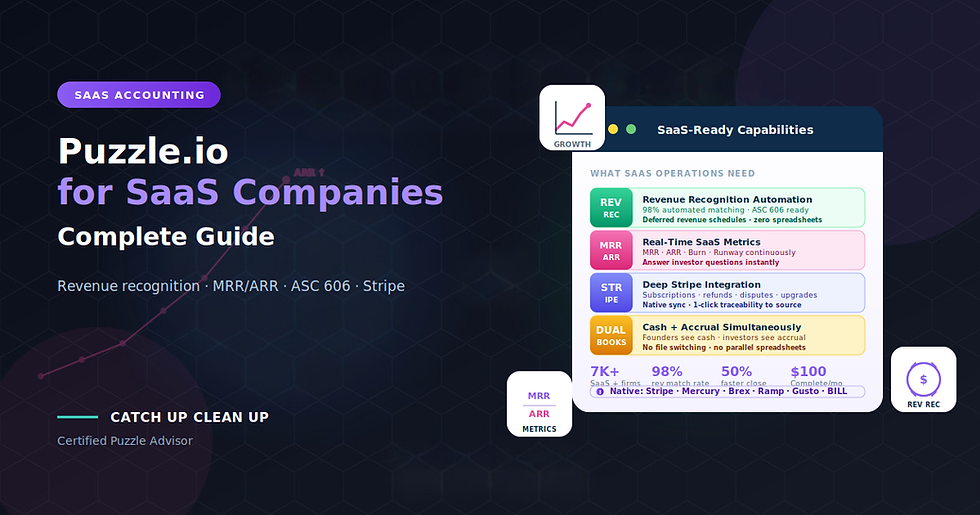
Founded in 2019 by Sasha Orloff and John Cwikla, Puzzle has raised $66.5 million and reports over 7,000 customers. The platform focuses specifically on US-based startups on modern fintech stacks.
Key differentiators:
Deep native Stripe integration handling subscription complexity
Dual cash and accrual books simultaneously
98% automated transaction matching
Native fintech integrations (Mercury, Brex, Ramp, Gusto)
Certified Puzzle Advisor program with directory listing
Explicit commitment to never compete with accountant firms
Best fit: US-based SaaS and technology startups with modern fintech stacks. Not suitable for Shopify e-commerce, international operations, or inventory-heavy businesses.
For a comprehensive Puzzle overview, see our What Is Puzzle.io? The Complete Guide for Startup Founders.
Rillet
Rillet covers general ledger, multi-entity consolidation, revenue recognition, and financial reporting in a cloud platform. Their AI agents automate journal entries, reconciliation, and close workflows.
Key differentiators:
Multi-entity consolidation built in
Deep integrations with Stripe, Salesforce, Ramp, Brex, BILL, Avalara
Custom pricing quoted after demo
All features in a single tier
Best fit: Growing companies needing multi-entity consolidation with AI-automated workflows.
Campfire
Campfire is a cloud ERP built around an AI assistant called Ember. The platform handles general ledger, revenue recognition, account reconciliation, cash forecasting, and multi-entity consolidation across 180+ currencies.
Key differentiators:
Multi-currency support (unlike Puzzle)
Cash forecasting capabilities
AI assistant (Ember) for natural language interaction
ERP breadth beyond basic accounting
Best fit: International startups or growing companies needing ERP capabilities with AI enhancement.
Other AI-native platforms
Additional platforms competing in the AI-native space include:
Numeric: Focus on close automation and financial reporting for growth companies.
Truewind: AI-first bookkeeping service for startups combining software with services.
Zeni: Full-service AI-powered bookkeeping combining platform with human accountants.
DualEntry: AI-native ERP for growing businesses seeking automation depth.
Each platform has specific strengths and target customers. The AI-native segment isn't a single-winner market yet. Different platforms fit different business types, and the segment continues evolving rapidly.
What legacy platforms are doing
Legacy platforms aren't standing still. They're actively adding AI features:
QuickBooks Online (Intuit):Intuit Assist AI features. Improved categorization suggestions. AI-powered insights. Continuing investment in AI capabilities within their existing architecture.
Xero: Similar AI feature additions. Machine learning for bank feeds. AI-assisted invoice processing. Continued investment in modernization.
NetSuite (Oracle):Oracle's broader AI investments extending to NetSuite. Enterprise-grade AI features for larger customers.
Sage Intacct: AI features for mid-market operations. Focus on their core customer base rather than startup-specific needs.
These legacy platform investments in AI matter. They ensure the platforms remain competitive for their core markets. But architectural limitations prevent them from fully matching AI-native platforms in productivity gains. Both categories can coexist, serving different market segments effectively.
For related context on comparing specific platforms, see our upcoming post on Puzzle vs QuickBooks Online: Complete Comparison for Startups.
Should your startup make the switch?
The abstract case for AI-native accounting is clear. The specific decision for your startup depends on your particular situation.
Strong indicators to consider switching
Modern fintech stack usage: If you're on Stripe, Mercury or Brex, Ramp, and Gusto, AI-native platforms often integrate more cleanly than QuickBooks. The productivity gains apply immediately.
Real-time metrics needs: If you regularly need current burn, runway, MRR, or ARR figures, AI-native platforms provide these continuously versus requiring compilation from QuickBooks.
Growth trajectory requiring scale: If you're growing rapidly and expect complexity to increase, starting on a platform built for growth is easier than migrating later at higher complexity.
Fundraising within 12 months: If you're preparing for institutional funding, audit-ready books and diligence-ready reporting come more naturally from AI-native platforms.
Team expanding beyond founder: If you're adding finance team members, unlimited-user pricing on AI-native platforms often beats per-user pricing on QuickBooks.
QBO Plus users hit by 2026 price increases: If you're paying $140/month for QBO Plus with the recent increases, comparable AI-native plans often cost less with more relevant features.
Frustration with current platform: If you're actively frustrated with your current accounting platform's limitations, that frustration is a signal worth acting on rather than tolerating indefinitely.
Strong indicators to stay put
Legacy operations with clean books: If your current platform works well and books are clean, the migration effort may not justify the improvement. Working systems have real value.
Business model doesn't match AI-native fit: E-commerce on Shopify needs A2X plus QuickBooks or Xero. International operations need multi-currency. Complex inventory needs specialized handling. AI-native platforms don't fit these business models well.
Small operation without complexity: Very small operations with simple books may not benefit enough from platform switch to justify the effort. Simple businesses can run adequately on many platforms.
CPA relationship strongly favors current platform: If your CPA charges significantly more for non-QuickBooks work or resists platform changes, factor that friction into decisions.
No specific pain points: Change for its own sake isn't valuable. If your current platform genuinely serves your needs without significant friction, waiting for stronger indicators makes sense.
The transition consideration
If indicators suggest switching, timing matters:
Best transition timing:
Start of a quarter or fiscal year
Between major business events (not during fundraising)
When you have team capacity to support migration
When your accounting is current (not backdated)
Worst transition timing:
During active fundraising
At tax season
During major business changes
When books are behind
The transition itself typically takes 30-90 days depending on complexity. Planning for this timeline rather than expecting instant switches produces better outcomes.
What does this shift mean for founders today?
The broader industry shift toward AI-native accounting has specific implications for how founders should think about their financial infrastructure.
The strategic implications
Platform decisions now have longer implications: The gap between AI-native and legacy platforms will grow over the next several years, not shrink. Platform decisions today lock you into paths that diverge going forward.
Advisor selection matters more: Working with advisors who understand AI-native platforms provides advantages beyond just platform choice. Advisors familiar with modern tools deliver better outcomes than those trained only on legacy systems.
Integration ecosystem matters: Your accounting platform choice affects your entire financial infrastructure. Native integrations reduce complexity throughout your stack, not just at the accounting layer.
Real-time capabilities enable new decision patterns: When financial data is always current, decision-making patterns change. Faster iteration on pricing. Earlier detection of trends. Better fundraising positioning. These second-order effects compound over time.
The tactical implications
Evaluate platforms objectively: Don't switch based on marketing hype. Don't stay based on inertia. Evaluate specific fit for your business objectively, weighing real productivity gains against real migration costs.
Consider timing carefully: Platform switches during fundraising or tax season create unnecessary risk. Plan switches during calm periods with team capacity for the transition.
Involve your accountant in decisions: Your accountant's platform expertise affects execution quality. Include them in platform evaluation. Consider whether their expertise fits your platform direction.
Test before committing: Free trials, limited pilots, or parallel operations let you evaluate platform fit without full commitment. Use these opportunities rather than committing based on demos alone.
Plan for change beyond just software: Platform switches often reveal opportunities to improve processes, restructure accounting, and modernize other financial operations. Plan for holistic modernization rather than just software switching.
The advisory implications
The shift toward AI-native accounting changes what value accounting advisors provide:
Less value from data entry: When AI handles routine categorization and reconciliation, advisors who charge for data entry become less relevant. Value shifts toward judgment, expertise, and advisory.
More value from platform expertise: Advisors deeply familiar with AI-native platforms provide value beyond software use. They optimize workflows, leverage advanced features, and coordinate across the modern startup stack.
More value from strategic advisory: Time freed from data entry enables advisors to provide strategic value: fundraising support, metrics interpretation, growth planning, and CFO-level input beyond pure bookkeeping.
Certified advisor programs matter more: Platforms increasingly certify advisor firms specifically for their tools. Working with certified advisors provides quality signals that traditional certifications don't capture. See our guide on working with a Certified Puzzle Advisor for context on how modern advisor programs work.
The Bottom Line
Startups aren't moving beyond QuickBooks because AI accounting is fashionable. They're moving beyond it because the underlying requirements of modern startup operations have diverged from what QuickBooks was designed to serve. AI-native platforms built specifically for these requirements provide genuine structural advantages that legacy platforms can't fully match regardless of AI feature additions.
The productivity gaps between AI-native and AI-enhanced platforms aren't marginal. Reconciliation times dropping from hours to minutes. Close cycles shrinking by 50%. Categorization accuracy climbing from 60% to 98%. Firm capacity multiplying 3-6x. These are structural improvements from architecture, not incremental improvements from features.
The market data confirms adoption is real and accelerating. 70% of U.S. accounting firms using AI weekly. 89% of AI users citing positive ROI. Market growth projected at 47.9% CAGR through 2034. This isn't hype cycle behavior. This is genuine market transformation.
But adoption isn't universal, and it shouldn't be. Established businesses with working systems on legacy platforms have real reasons to stay. Business models that don't fit AI-native platforms should use platforms that do fit. Very small operations may not benefit enough from switching to justify the effort. The right answer varies by specific situation.
For US-based startups on modern fintech stacks, particularly SaaS and technology companies, the case for evaluating AI-native platforms is strong. The QBO price increases in August 2026 make the financial case immediate. The productivity gains make the operational case compelling. The trajectory of platform improvements makes the strategic case clear.
The question isn't really whether AI-native accounting is the future. It clearly is for meaningful segments of the market. The question is whether your specific startup should participate in the transition now or wait until the market matures further.
For startups where AI-native platforms genuinely fit, waiting typically costs more than switching. Platform migration friction is highest when accounting is most complex. Migration during simpler phases creates advantages that compound during growth. Migration during fundraising or high-complexity periods creates unnecessary risk.
For startups where AI-native platforms don't clearly fit, honest evaluation prevents making changes for their own sake. Not every trend applies to every business. Not every "modern" solution improves specific operations. Matching your platform to your actual needs matters more than following industry trends.
The AI-native accounting shift is genuine, structural, and accelerating. Understanding what it means, evaluating what it means for your specific business, and making informed decisions based on your actual situation matter more than following any particular narrative. Whether you switch platforms or optimize your current setup, understanding the modern accounting landscape helps you make better choices for your startup's specific trajectory.
Ready to evaluate whether your startup should move beyond QuickBooks?
Most startup founders we work with came to us with similar concerns about their accounting infrastructure. They noticed QuickBooks limitations but weren't sure whether alternatives were meaningfully better. They wondered if AI accounting was hype or genuine change. They saw the August 2026 QBO price increases and started evaluating options. They needed help thinking through whether platform switching made sense for their specific situation.
At Catch Up Clean Up, we're a Certified Puzzle Advisor, Intuit QuickBooks ProAdvisor, Xero Certified, and with deep experience AI-native platforms including Puzzle. We provide platform-agnostic advisory expertise based on your actual needs rather than promoting any specific platform. Our recommendations vary by client because business needs vary. What we consistently deliver is objective evaluation and informed guidance through platform decisions.
What you get:
A 30-minute scoping call to assess your specific situation
Objective platform evaluation without vendor bias
Analysis of whether AI-native platforms actually fit your business
Cost-benefit comparison specific to your operations
Migration risk and timing assessment
Clear recommendation with rationale
If migration recommended: complete execution support
Platform-specific setup optimization
Historical data migration if switching
Ongoing bookkeeping across whichever platform fits
Strategic advisory beyond just bookkeeping
Certified Puzzle Advisor expertise for that segment
QuickBooks Online expertise for that segment
Xero expertise for that segment
Real-time financial dashboards regardless of platform
Book a free consultation and let's discuss whether moving beyond QuickBooks makes sense for your startup.
Frequently Asked Questions
What does AI-native accounting mean?
AI-native accounting means the platform architecture was built from the ground up around AI capabilities rather than adding AI features to legacy architecture. AI operates throughout the platform continuously rather than as separate manual-triggered features. This produces structural productivity gains rather than incremental improvements.
Are AI-native platforms really better than QuickBooks?
For US-based startups on modern fintech stacks, AI-native platforms typically provide meaningful advantages including real-time metrics, better integrations, higher automation accuracy, and startup-specific features. For traditional small businesses, established operations with working systems, and businesses outside the modern startup profile, QuickBooks often remains the better choice.
How much productivity improvement do AI-native platforms provide?
Documented productivity improvements include reconciliation times dropping from 2 hours to 5 minutes, close cycles shrinking up to 50%, categorization accuracy climbing from 60-75% to 90-98%, and firm capacity multiplying 3-6x. Actual gains depend on how fully organizations adopt the tools and restructure workflows around them.
Should I switch platforms because of the QuickBooks price increase?
Price increases alone shouldn't drive platform decisions. However, the August 2026 QBO price increases (41% for Plus, 70% for Advanced) make alternatives that were already competitive even more compelling. Evaluate whether AI-native platforms fit your business, then factor in pricing as one consideration among several.
Which AI-native platform is best for my startup?
Platform fit depends on your specific situation. Puzzle fits US-based startups on Stripe, Mercury, Brex, and Ramp particularly well. Rillet suits multi-entity operations. Campfire fits international startups needing multi-currency. Numeric focuses on close automation. Evaluate specific fit rather than assuming any single platform is universally best.
How long does a platform migration take? Basic setup on AI-native platforms happens in days through native integrations. Full transition including historical data migration, AI training, and workflow refinement typically takes 30-90 days depending on complexity. Plan migrations during calm periods rather than during fundraising or tax season.
Are AI accounting platforms secure?
Established AI-native platforms typically maintain SOC 2 compliance with read-only integrations. Puzzle, for example, uses read-only integrations meaning the platform can never modify source financial systems. Evaluate specific security certifications and integration approaches when comparing platforms.



Comments